
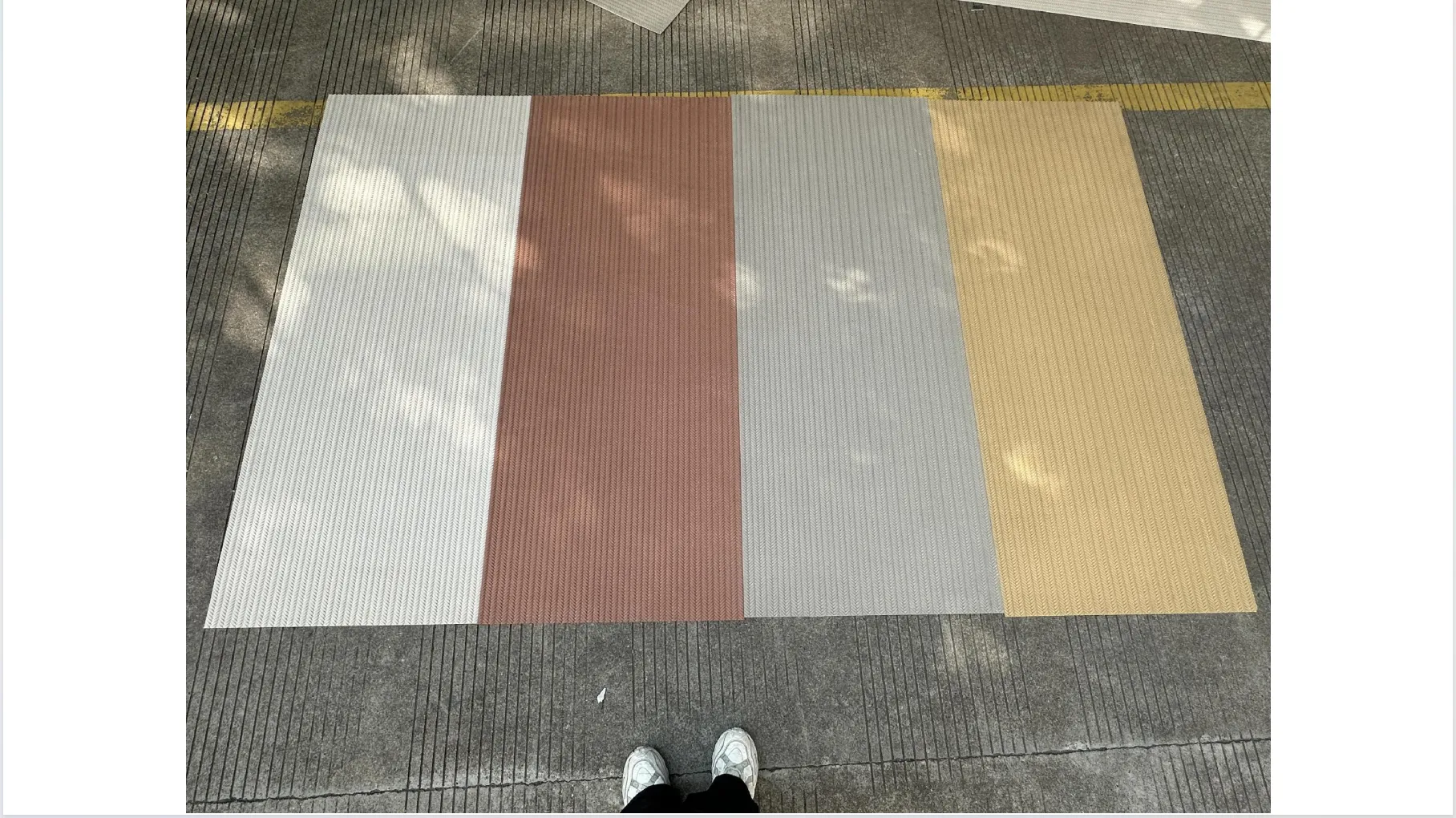
Walk into any space—whether a cozy café, a sleek office lobby, or a historic home—and the first thing that often hits you isn't just the color scheme or layout. It's the texture of the materials surrounding you. A rough-hewn brick wall might evoke warmth and nostalgia, while a smooth concrete surface feels modern and industrial. But what if there was a texture that bridges the gap between softness and durability, between organic warmth and architectural strength? That's where MCM's woven textures come in. In this article, we'll dive into the world of tactile design, exploring how MCM's weaving (khaki) and weaving (grey) textures stack up against two stalwarts of architecture: fair-faced concrete and traditional brick. By the end, you'll understand not just their visual differences, but how they make us feel —because in design, emotion matters as much as aesthetics.
Texture is the unsung hero of interior and exterior design. It's the reason a room feels "cold" even with on, or "inviting" despite minimal decor. Texture speaks to our senses: the way a wall feels when we brush a hand against it, the way light plays across its surface at different times of day, the subtle shadows that add depth to a flat facade. Architects and designers have long used texture to craft narratives—industrial spaces lean into concrete's raw edges to tell stories of innovation, while rustic homes wrap themselves in brick to whisper of heritage. MCM's woven textures, though, tell a different tale: one of balance, where man-made precision meets nature's organic flow.
But why compare woven textures to concrete and brick specifically? Because these three materials represent distinct ends of the texture spectrum: woven textures are soft yet structured, concrete is hard and unyielding, and brick is sturdy with a touch of warmth. Together, they showcase how texture can transform a space's personality—from cozy to clinical, from timeless to cutting-edge.
Imagine running your fingers over a textile that's been frozen in time, its threads woven so tightly they feel solid, yet retain the flexibility of fabric. That's the magic of MCM's woven textures. Take weaving (khaki) , for example: a warm, earthy tone that mimics the look of handwoven jute or hemp. The texture is intricate—tiny ridges and valleys where the "threads" overlap, catching light in a way that softens even the brightest sunbeams. It's not just a print or a pattern; it's a three-dimensional surface that invites touch, as if the wall itself is a textile crafted by skilled hands.
Then there's weaving (grey) , a cooler counterpart that leans into modern minimalism. Its threads are slightly more refined, with a tighter weave that gives it a sleek, almost metallic sheen in certain lights. Unlike flat paint or even wallpaper, which can feel one-dimensional, MCM's woven textures have depth . Stand back, and they read as a subtle, organic pattern; step close, and you'll notice the interplay of light and shadow, as if the material is breathing. It's a texture that works equally well in a bohemian living room (paired with macramé and potted plants) or a contemporary restaurant (contrasted with steel and glass).
What makes these woven textures truly special, though, is their durability. MCM (Modified Composite Material) is engineered to withstand the elements—rain, wind, UV rays—without fading or fraying. So that cozy, textile-like feel isn't just for show; it's built to last, making it ideal for both interior accent walls and exterior facades. It's the best of both worlds: the warmth of natural fibers with the resilience of modern technology.
Fair-faced concrete—also known as "architectural concrete"—is the opposite of subtle. It's raw, unapologetic, and intentionally imperfect. Unlike regular concrete, which is often covered in paint or plaster, fair-faced concrete is left exposed, showcasing the marks of its creation: the texture of the formwork (wooden planks, metal sheets), tiny air bubbles, and slight color variations. It's a texture that screams "utility" and "strength," with a surface that's cold to the touch and visually heavy. Think of a warehouse conversion or a modern art museum—the kind of spaces that feel bold, uncompromising, and slightly futuristic.
But here's the thing about fair-faced concrete: its texture is uniformly rough . There's little variation in its pattern—no soft peaks or valleys, just a consistent, gritty surface that reflects light harshly. It's a texture that commands attention, but it rarely invites intimacy. A room lined with fair-faced concrete can feel imposing, even sterile, unless balanced with softer elements like plush rugs or warm lighting. It's durable, yes—resistant to fire, water, and wear—but it doesn't adapt to mood. It is what it is: a statement of industrial strength.
Compare that to MCM's woven textures. Where concrete is monolithic, woven is layered. Where concrete feels like a barrier, woven feels like a wrap —a material thats a space rather than dominating it. It's the difference between standing in a factory and sitting in a handcrafted tent: both are functional, but one feels human, and the other feels… machine-made.
Brick has been around for millennia, and for good reason. Its texture is iconic: small, rectangular units stacked in neat rows, with mortar lines that add subtle variation. Traditional red brick feels warm and familiar, like a grandmother's kitchen or a historic town square. Modern brick, though, comes in sleek grays and blacks, with smoother surfaces that blend into contemporary designs. But no matter the color, brick's texture is inherently structured . It's a grid of order, a visual rhythm that feels reassuring and stable.
But brick's texture is also limited by its form. Each brick is a uniform shape, so even when laid in a herringbone or basketweave pattern, the overall effect is repetitive. The mortar lines, while adding texture, are often straight and predictable. It's a texture that tells a story of tradition and reliability, but it rarely surprises. Run a hand over a brick wall, and you'll feel the hard edges of each unit, the grit of the mortar, but little of the softness or complexity found in woven textures.
MCM's woven textures, by contrast, are organic . They don't follow a grid—instead, they mimic the irregularity of natural fibers, where no two "threads" are exactly alike. Weaving (khaki) , for instance, has a slight variation in thread thickness, as if the weaver's hands loosened and tightened their grip as they worked. It's a texture that feels alive, as if it might shift subtly in different lights. Brick is a chorus singing in unison; woven is a jazz ensemble, each instrument improvising to create harmony.
To truly understand the differences, let's break down these textures by the criteria that matter most to designers and homeowners alike. The table below compares MCM's weaving (khaki) , fair-faced concrete, and traditional brick across key factors like tactile feel, emotional impact, and practical use.
| Criteria | MCM Weaving (Khaki) | Fair-Faced Concrete | Traditional Brick |
|---|---|---|---|
| Texture Type | Organic, woven textile-like; soft peaks and valleys | Industrial, uniform grit; rough, unpolished surface | Structured, grid-like; hard edges with mortar lines |
| Visual Impact | Soft, warm, and dynamic; catches light to create depth | Bold, stark, and monolithic; reflects light harshly | Classic, reassuring, and rhythmic; consistent pattern |
| Tactile Feel | Subtly ridged yet smooth; invites touch (feels like fabric) | Cold, hard, and gritty; may feel abrasive to the touch | Hard, angular; mortar lines add slight grit |
| Durability | High (MCM resists fading, moisture, and wear) | Extremely high (resistant to fire, weather, and impact) | High (but mortar may crack over time; porous to moisture) |
| Best For | Cozy interiors (cafés, bedrooms), accent walls, bohemian or modern exteriors | Industrial spaces (lofts, galleries), minimalist exteriors, high-traffic areas | Historic renovations, traditional homes, garden walls, rustic interiors |
| Emotional Resonance | Inviting, warm, creative; feels "human-made" and artisanal | Strong, innovative, detached; feels "machine-made" and futuristic | Nostalgic, reliable, grounded; feels "time-tested" and communal |
Let's step into three hypothetical spaces to see how these textures play out in real life.
The Cozy Café: Imagine a small coffee shop in a bustling city. The walls are clad in MCM's weaving (grey) —soft, neutral, and warm. Sunlight filters through large windows, casting dappled shadows on the woven surface, making the space feel like a cozy blanket. Customers linger longer, drawn to the tactile warmth of the walls. Compare this to the same café with fair-faced concrete walls: the space would feel larger but colder, more like a transit hub than a place to relax. Brick walls might add warmth, but the structured grid could make the small space feel cramped, as if the walls are closing in.
The Modern Office Lobby: A tech company wants to project innovation and creativity. They choose fair-faced concrete for the main facade—it's bold, unapologetic, and screams "forward-thinking." But inside, they use MCM's weaving (khaki) on the reception wall. The contrast is striking: the industrial exterior gives way to a soft, organic interior, telling visitors, "We're innovative, but we value humanity too." Brick here would feel out of place—too traditional for a company pushing boundaries.
The Historic Home Renovation: A 1920s bungalow is being updated for modern living. The exterior retains its original red brick—warm, familiar, and in keeping with the neighborhood's character. Inside, though, the living room features an accent wall of weaving (grey) . The woven texture softens the brick's structured feel, adding a layer of modernity without losing the home's historic charm. Fair-faced concrete here would clash, feeling too cold against the home's vintage details.
At the end of the day, the "best" texture depends on the mood you want to create. If you're after a space that feels innovative and unyielding, fair-faced concrete is your ally. If you want to honor tradition and stability, brick won't let you down. But if you're craving warmth, creativity, and a texture that feels alive —one that invites touch and tells a story of craftsmanship—MCM's woven textures, like weaving (khaki) and weaving (grey) , are in a league of their own.
Texture is more than just a design choice; it's a language. And MCM's woven textures speak in a dialect that's both timeless and contemporary, soft and strong, human and durable. So the next time you're designing a space, don't just look at the materials— feel them. Let your fingers guide you, and let your heart decide. After all, the best spaces aren't just seen—they're experienced.
Recommend Products












