
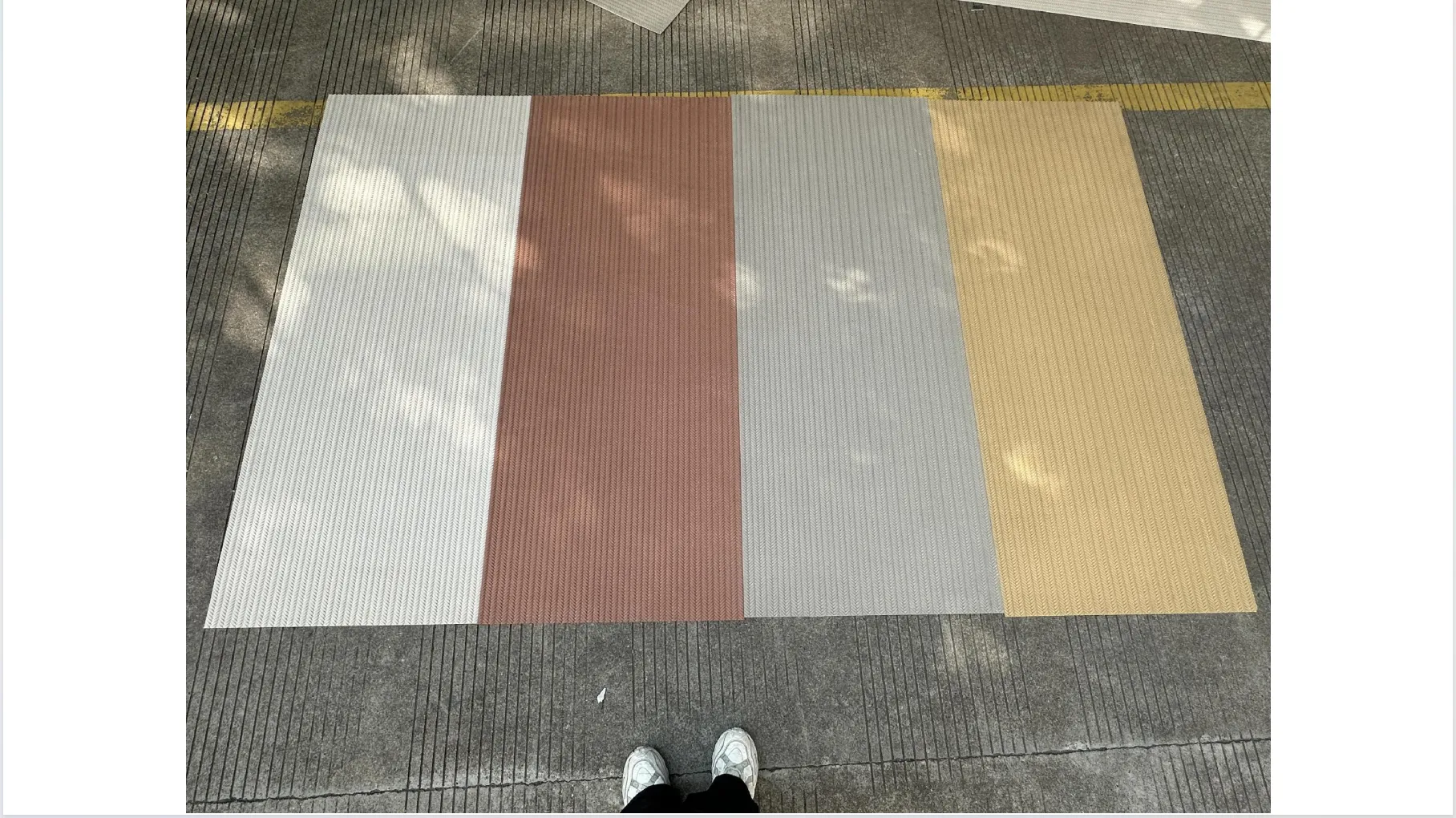
Walk into any modern building materials showroom, and you'll likely be greeted by a wall of products labeled "eco-friendly," "sustainable," or "green." From kitchen backsplashes to commercial facades, the promise of doing good for the planet has become a cornerstone of the industry. But here's the catch: how do you know if that "sustainable" tile or panel is actually as green as it claims? For architects, contractors, and homeowners alike, this question isn't just about ethics—it's about investing in materials that deliver on their environmental promises without sacrificing performance.
Enter woven real photos. No, they're not just pretty pictures for brochures. These high-resolution, unfiltered images are emerging as silent certifiers, bridging the gap between marketing claims and tangible proof. In a world where "greenwashing" (the practice of making misleading eco-friendly claims) is all too common, woven real photos offer a window into the soul of a material—its texture, its composition, its story. And when it comes to MCM (Modified Composite Material) products, this visual storytelling is more critical than ever.
Before diving into the role of photos, let's get clear on what MCM materials are. Short for Modified Composite Material, MCM is a game-changer in the building industry. Think of it as a hybrid: a blend of natural minerals (like stone or clay), recycled polymers, and other sustainable additives, engineered to be lightweight, flexible, and durable. Unlike traditional stone or concrete, which can be heavy, brittle, and resource-intensive to extract, MCM products are designed to mimic the look and feel of natural materials while cutting down on environmental impact.
Take mcm flexible stone , for example. It's a popular MCM variant that bends and curves without cracking, making it ideal for unique architectural designs—think curved walls or rounded columns. Then there's the mcm big slab board series , which offers large-format panels (some as big as 1200x2400mm) with minimal seams, reducing installation waste. And let's not forget woven (beige) , a textured MCM option that mimics the look of handwoven fabric, made partially from recycled plastic bottles. These products aren't just innovative—they're built with sustainability in mind. But how do you prove that to a skeptical buyer?
Here's a troubling statistic: according to a 2023 survey by the Green Building Council, nearly 40% of building materials marketed as "eco-friendly" fail to meet basic sustainability criteria when independently tested. That's a lot of products making empty promises. The problem? Many eco-claims rely on vague terms like "recycled content" or "low VOCs" (volatile organic compounds) without providing evidence. A label might say "50% recycled materials," but what does that look like? Is it visible in the product's texture? Can you see the difference between recycled and virgin materials?
This is where woven real photos step in. Unlike stock images or heavily edited marketing shots, woven real photos are taken in real-world conditions—on construction sites, in labs, or in natural light. They show the material up close: the way light hits its surface, the tiny imperfections that make it authentic, and yes, even the signs of its sustainable composition. For instance, a photo of woven (beige) might reveal the subtle flecks of recycled plastic woven into its pattern, or the way its edges fray slightly (a sign of its flexibility, not poor quality). These details aren't just aesthetic—they're proof points.
Research shows that people are 3 times more likely to trust a product when they can see it "as is," without filters. In a study by the Design Institute of America, architects reported that they were 65% more confident recommending an MCM product if they'd seen high-quality real photos of it in use. Woven real photos don't just show a product—they tell a story of transparency. When you can zoom in on a mcm flexible stone panel and see the recycled glass particles embedded in its surface, or notice how a mcm big slab board panel connects seamlessly (reducing grout waste), you're not just looking at a material—you're verifying its eco-claims with your own eyes.
Let's take a closer look at how woven real photos are certifying MCM materials in the real world. We'll focus on three key products: mcm flexible stone , mcm big slab board series , and woven (beige) . For each, we'll explore how photos highlight their sustainability features and build trust.
Traditional stone is rigid—bend it, and it breaks. Mcm flexible stone , on the other hand, can flex up to 30 degrees without cracking, thanks to its composite structure. But how do you prove flexibility without physically handling the product? Enter woven real photos. A series of photos taken during a bend test (yes, real bend tests!) shows the stone curving around a metal rod, with no visible cracks or chips. Another photo might zoom in on the back of the panel, revealing the mesh-like reinforcement layer made from recycled polyester—a material that gives it flexibility while keeping it lightweight.
But it's not just about flexibility. Photos also show the stone's installation process. A time-lapse series might capture workers carrying large sheets of mcm flexible stone by hand (no heavy machinery needed, reducing carbon emissions) or cutting it on-site with a standard utility knife (minimizing dust and waste). These images tell a story of efficiency: less energy used in transport, less waste in installation—both key pillars of sustainability.
The mcm big slab board series is all about reducing waste. Traditional stone slabs are often small (600x600mm), requiring dozens of pieces to cover a wall—each with seams that need grout, and each increasing the risk of breakage. MCM big slabs, by contrast, can be as large as 2400x1200mm, meaning fewer panels, fewer seams, and less waste. But how do you show that in a photo? Simple: a wide-angle shot of a completed wall using big slabs. Count the seams—there might be only 2 or 3, compared to 20+ with smaller tiles. A close-up photo of the seam itself shows how tight the fit is, reducing the need for excess grout (which often contains harmful chemicals).
Another photo might compare the waste from installing traditional stone vs. MCM big slabs. On one side: a pile of broken tile shards and leftover grout. On the other: a small bag of dust from cutting the MCM panels (which, by the way, is non-toxic and can be recycled). These side-by-side images make the sustainability claim tangible—you can see the reduced waste, not just read about it.
Woven (beige) is a fan favorite for interior designers, thanks to its warm, organic look. But its real beauty lies in its composition: 40% of its material comes from recycled plastic bottles, and 30% from post-industrial stone dust. How do you show that? Through macro photos. A zoomed-in shot of woven (beige) reveals the "weave" pattern: thin strands of recycled plastic twisted together with stone particles. You can see the slight variation in color—darker flecks here, lighter there—which comes from the mix of recycled materials. There are no two panels exactly alike, and that's a good thing: it means the product isn't relying on virgin materials to achieve a uniform look.
Photos also highlight its durability. A before-and-after shot of a woven (beige) panel installed in a high-traffic hallway: after 6 months, there are no scratches, no fading, and the color is just as rich as day one. This addresses a common concern with recycled materials—that they're less durable. The photo says otherwise.
Not all real photos are created equal. To be useful for certification, woven real photos need to capture specific details. Here's a breakdown of what architects, contractors, and homeowners should look for:
| Feature to Check | What It Reveals About Sustainability | Example in MCM Materials |
|---|---|---|
| Texture Variation | Sign of natural or recycled materials (uniformity often means heavy processing) | Woven (beige) has irregular flecks from recycled plastic/stone dust |
| Edge Flexibility | Indicates lightweight, flexible composition (reduces transport emissions) | Mcm flexible stone bends slightly at the edges without cracking |
| Seam Visibility | Fewer seams = less installation waste and grout use | Mcm big slab board series panels have tight, almost invisible seams |
| Recycled Content Clues | Flecks, strands, or discoloration from recycled materials | Plastic strands in woven (beige) ; stone dust in mcm flexible stone |
| Weathering Resistance | Color fastness and texture retention (reduces replacement frequency) | Outdoor photos of mcm big slab board series after rain/sun exposure |
These details might seem small, but together, they paint a picture of a material's true sustainability. A photo that skips these details—say, a overly edited shot with perfect lighting and no texture—might be hiding something. Woven real photos don't hide; they reveal.
Of course, using woven real photos for certification isn't without challenges. For one, lighting can drastically change how a material looks. A photo taken in harsh artificial light might make woven (beige) look washed out, hiding its texture. An angle that's too close might exaggerate a minor imperfection, making the material seem low-quality. To address this, the MCM industry is starting to adopt standards for real photos: photos must be taken in natural light, at a consistent distance (1 meter for close-ups, 5 meters for full panels), and with no filters or color correction. Some companies even include a color calibration chart in the photo (like a small gray card) to prove the colors are accurate.
Another challenge is consistency. A material might look different in a factory vs. on a construction site. That's why "in-situ" photos—taken after installation—are becoming more popular. A photo of mcm flexible stone on a completed wall, with furniture and people nearby, gives a better sense of how it performs in real life than a studio shot. It shows how it interacts with its environment, which is key for sustainability: a material that looks good in a lab but fades in sunlight isn't truly eco-friendly (it will need to be replaced sooner, creating more waste).
Woven real photos are just the beginning. The next frontier? Integrating them with digital certifications. Imagine scanning a QR code on a mcm big slab board panel and being taken to a gallery of woven real photos—plus links to lab reports, carbon footprint data, and even the origin of its recycled materials. Some MCM manufacturers are already doing this: their product photos include hidden QR codes that unlock a "transparency dashboard." You can see where the recycled plastic came from (e.g., a bottle recycling plant in Texas), how much CO2 was saved by using recycled materials, and even the names of the workers who made the panel. It's visual proof meets digital accountability.
There's also talk of AI-powered photo analysis. Imagine uploading a woven real photo of an MCM material to an app, and the app instantly identifies its recycled content, checks for compliance with green building standards (like LEED or BREEAM), and flags any red flags (e.g., signs of heavy chemical processing). This would make certification faster, more accurate, and accessible to everyone—from homeowners to large contractors.
In the end, woven real photos are more than just tools for certification—they're storytellers. They tell the story of a material's journey: from recycled bottles to a beautiful wall panel, from stone dust to a durable floor tile. They bridge the gap between "trust me" and "see for yourself." For MCM materials like mcm flexible stone , mcm big slab board series , and woven (beige) , this storytelling is critical. It turns abstract sustainability claims into something you can touch, see, and believe in.
So the next time you're evaluating an eco-friendly building material, don't just read the label—ask for the photos. Look for the texture, the variation, the signs of recycled content. Let the material speak for itself. Because in the world of green building, the truest certification isn't a stamp or a logo—it's a photo that tells the truth.
Recommend Products












