
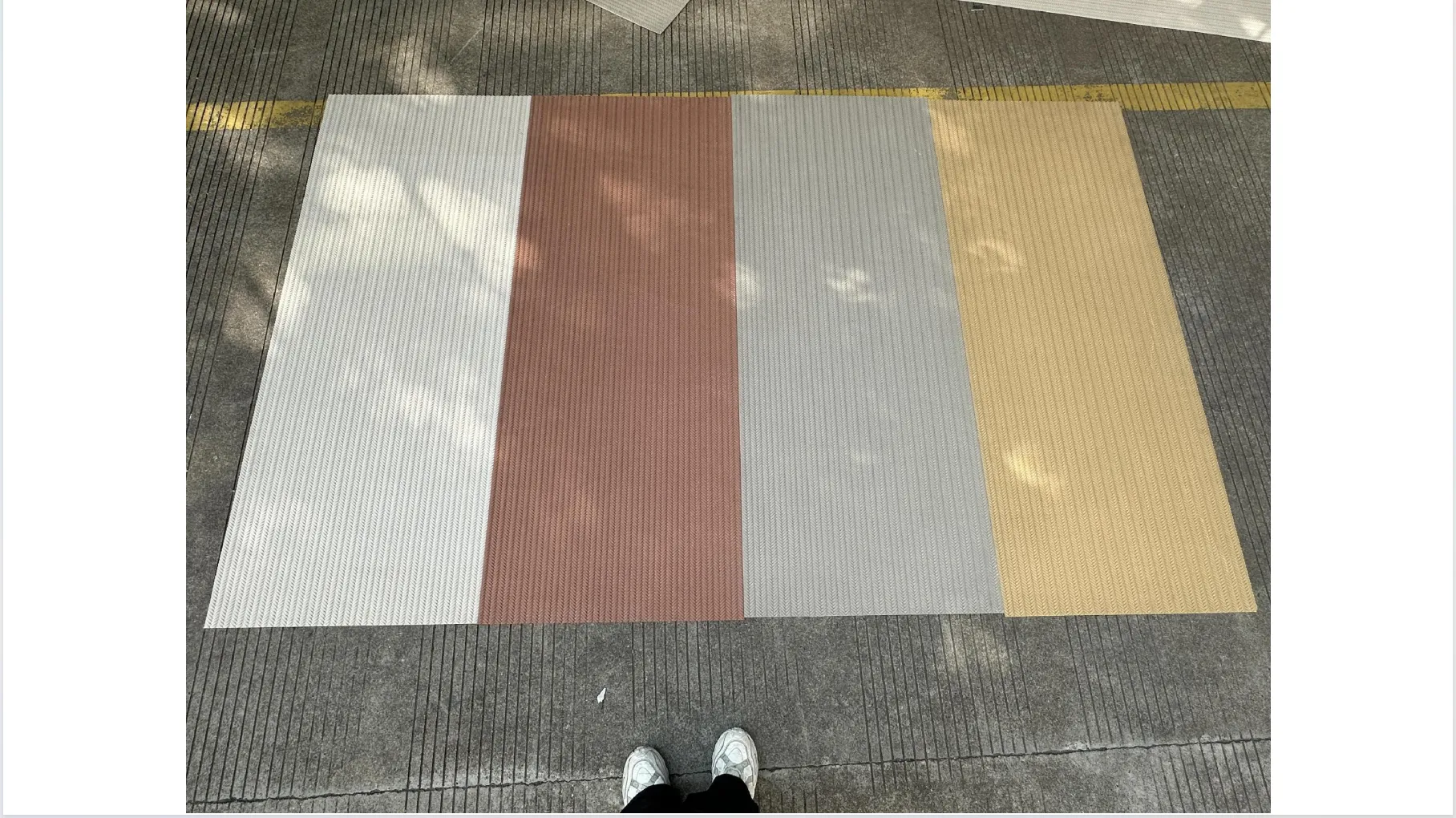
Walk into a thoughtfully designed space, and your first impression isn't just about color or layout—it's about touch. The rough-hewn warmth of a stone wall, the smooth coolness of polished concrete, the soft grain of wood under your fingertips—these textures, paired with subtle variations in thickness, shape how we feel in a room. They turn houses into homes, offices into inspirations, and public spaces into stories. In modern architecture and interior design, MCM (Modified Composite Material) has emerged as a game-changer, offering a universe of textures and thicknesses that mimic nature's best while adding flexibility and durability. And at the heart of choosing the right MCM material? Woven real photos—not just images, but windows into how a material will live in your space.
MCM isn't just another building material—it's a bridge between nature and innovation. Crafted from natural minerals, polymers, and fibers, these materials capture the look and feel of stone, wood, concrete, and metal, but with a lightweight, flexible edge. Imagine a stone panel that bends around a curved wall, or a wood-grain sheet that weighs half as much as solid timber—MCM makes that possible. But what truly sets MCM apart is its attention to texture and thickness. Unlike mass-produced synthetics that feel flat or artificial, MCM materials breathe with the same nuances as their natural counterparts: the porous surface of travertine, the knotty character of aged wood, the industrial grit of fair-faced concrete. And to showcase these details, woven real photos become indispensable. They don't just show a color swatch; they zoom in on the tiny pores of travertine, the direction of wood grains, the subtle indentations of a woven pattern—details that make or break how a material feels in real life.
Woven real photos are more than high-resolution images—they're storytelling tools. Think of them as a designer's handshake with a client: "Here's exactly how this wall will feel when you run your hand across it." For MCM materials, which often mimic natural textures, these photos solve a critical problem: how to convey the tactile through the visual . A flat image might show "wood grain," but a woven real photo reveals whether the grain is raised or smooth, whether the edges are soft or sharp, how light catches the surface at different angles. Take weaving (khaki) , for example. A woven real photo of this MCM material doesn't just show a khaki-colored sheet; it captures the interlacing threads, the slight shadow between each weave, the way the color deepens where the threads overlap. It's the difference between saying "it looks like fabric" and knowing exactly how that fabric would drape over a column or feel under your palm.
MCM Flexible Stone: Where Thickness Meets Versatility
If there's one MCM material that embodies "flexible strength," it's MCM flexible stone . Typically ranging from 3mm to 5mm thick—about the width of two credit cards stacked together—this material bends and curves without cracking, making it perfect for unconventional designs: a rounded fireplace surround, a wavy accent wall in a hotel lobby, or even custom furniture panels. But don't let its thin profile fool you—its texture is pure natural stone. Run your hand over a sample, and you'll feel the same cool, slightly gritty surface as a quarry-cut limestone, with tiny pits and ridges that catch dust like a fingerprint. Woven real photos of MCM flexible stone often zoom in on these details: a close-up of the stone's surface reveals mineral deposits that glint in sunlight, while a wider shot shows the material draped over a curved surface, proving flexibility without sacrificing texture. It's a material that says, "I can go anywhere, and I'll still feel like real stone."
Travertine has long been a favorite in design for its porous, organic texture, but travertine (starry green) takes that to a celestial level. At around 4mm thick, this MCM variant is thin enough for ceiling panels or lightweight feature walls, but its texture is anything but delicate. The surface is dotted with tiny, iridescent "stars"—mineral deposits that catch light and shift color, from deep emerald to hints of silver, depending on the angle. Woven real photos of starry green travertine are like capturing a night sky in stone: macro shots highlight the star-like flecks, showing their size (some as small as a pinhead, others as large as a pencil eraser) and how they're scattered across the surface, never perfectly uniform. A side-angle photo reveals the thickness, too—how the 4mm panel sits flush against drywall, yet still has enough depth to cast a soft shadow, adding dimension to a wall. It's a material that turns a plain room into a conversation piece: "Is that… stone? It looks like it's glowing."
For lovers of industrial chic, fair-faced concrete is the epitome of "less is more." MCM's take on this classic material clocks in at 6-8mm thick—sturdy enough for exterior cladding but lightweight enough for interior accents. Its texture is a study in understatement: smooth but not glossy, with subtle imperfections that echo the hand-poured look of traditional concrete. You'll notice tiny air bubbles frozen in the surface, hairline "cracks" that are actually intentional texture, and a matte finish that softens light rather than reflecting it. Woven real photos of fair-faced concrete excel at capturing these nuances. A close-up might show a single air bubble, its edge slightly raised, or a streak of darker gray where the "concrete" mixture shifted during production—details that make the material feel alive, not manufactured. It's the texture of urban lofts, minimalist cafes, and spaces that value authenticity over polish. Stand in front of a wall clad in MCM fair-faced concrete, and you'll feel the calm of a rainy city street—the quiet strength of something built to last.
Nothing says "home" like the texture of wood, and wood grain board brings that warmth to MCM. At 5mm thick, it's thin enough to install as a backsplash or cabinet panel, but its texture is rich with the character of real timber. Run your hand across it, and you'll feel the slight rise of the grain, the smooth valleys between each line, and the subtle variation in color—darker here where a "knot" would be, lighter there like sun-bleached wood. Woven real photos of wood grain board often focus on these variations: a photo taken at eye level shows the grain direction (straight, wavy, or knotty), while a 45-degree shot captures how light plays across the surface, making the grain pop. It's the difference between choosing "oak" and knowing whether it's a young, smooth oak or an aged one with deep, gnarled lines. In a kitchen, this material feels like a hug; in a bedroom, it's a lullaby of natural warmth.
| Material | Typical Thickness | Texture Profile | Best For |
|---|---|---|---|
| MCM Flexible Stone | 3-5mm | Cool, porous, slightly gritty (mimics natural stone) | Curved walls, accent panels, furniture |
| Travertine (Starry Green) | 4mm | Porous with iridescent "star" flecks, uneven surface | Feature walls, hotel lobbies, statement ceilings |
| Fair-Faced Concrete | 6-8mm | Matte, with air bubbles and subtle "crackle" texture | Industrial interiors, exterior cladding, fireplace surrounds |
| Wood Grain Board | 5mm | Warm, with raised grain lines and knotty variations | Kitchen backsplashes, bedroom walls, cabinet doors |
Recommend Products












